Pillar 01 // Executive Decision Advantage
Quantify Threats. Secure Operations.
Anticipate attacks before execution. The Adversary Index provides an exact quantifiable metric scoring nation-state and non-state attackers. Gain defensible, estimative strategic foresight. Executive boards receive scored, sourced assessments to approve defensive budgets with confidence.
Inaugural release July 15, 2026. Next release October 5, 2026. The October release carries the Q3 refresh and the inaugural Cognitive Warfare Threat Report (CWTR). Defend your infrastructure proactively.
Executive Clarity
Quantify adversary threats. Make strategic decisions. Lock in your access.
Executives require definitive intelligence to protect infrastructure. Treadstone 71 fuses 24 years of doctrine into a single composite metric. Analysts integrate STEMPLES Plus, the Adaptive Cyber Intelligence Lifecycle, and Advanced Analytic Dominance SATs natively. Corporate boards and defense agencies purchase subscriptions to justify budget allocations. Stop reacting to fragmented vendor alerts. Subscribers receive actionable data mapping precise adversary capabilities.
- Who
- Treadstone 71 LLC. A pure-play intelligence consultancy founded in 2002.
- What
- The Adversary Index — a quarterly predictive scoring mechanism driving defensive strategy.
- Impact
- Replace anecdotal reporting with verified, comparable intelligence metrics.
- Why now
- Opponents deploy automated deepfakes and LLM-driven influence networks. Organizations must defend against machine-speed attacks immediately.
- Result
- Leaders allocate budgets accurately. Defenses align strictly to verified threat capacities.
- Outlook
- Early subscribers lock in strategic advantages. Shape the defensive methodology actively.
Defensive Architecture
Operational Metrics
Predict precise adversary movements
Analysts calculate a composite across eight distinct vectors. Teams score each vector 0 to 100 per adversary against a transparent rubric, then average the eight to set the composite. You receive a normalized output revealing exact operational maturity. Higher numbers dictate urgent defensive posturing. The index measures actual executed operations precisely. We apply anomaly and aggregation analysis to expose hidden patterns.
Cognitive Warfare Velocity
Measure narrative production speed. Counter hostile influence campaigns before they spread.
OPSEC Sophistication
Expose attacker security protocols. Uncover hidden infrastructure faster.
Adaptation / Evolution Index
Gauge adaptation speed under operational pressure. Anticipate actor re-tooling.
Narrative Volume
Track propaganda saturation. Isolate synthetic media within specific industries.
Sectoral Targeting Concentration
Identify exact industry targeting. Allocate defenses where attackers focus most.
AI Tradecraft Adoption
Anticipate artificial intelligence deployment. Upgrade technical defenses matching adversary capabilities.
Doctrinal Maturity
Evaluate long-term operational planning. Forecast multi-year campaign threats.
Operational Tempo
Determine attack frequency. Prepare for specific escalation patterns.
The Register
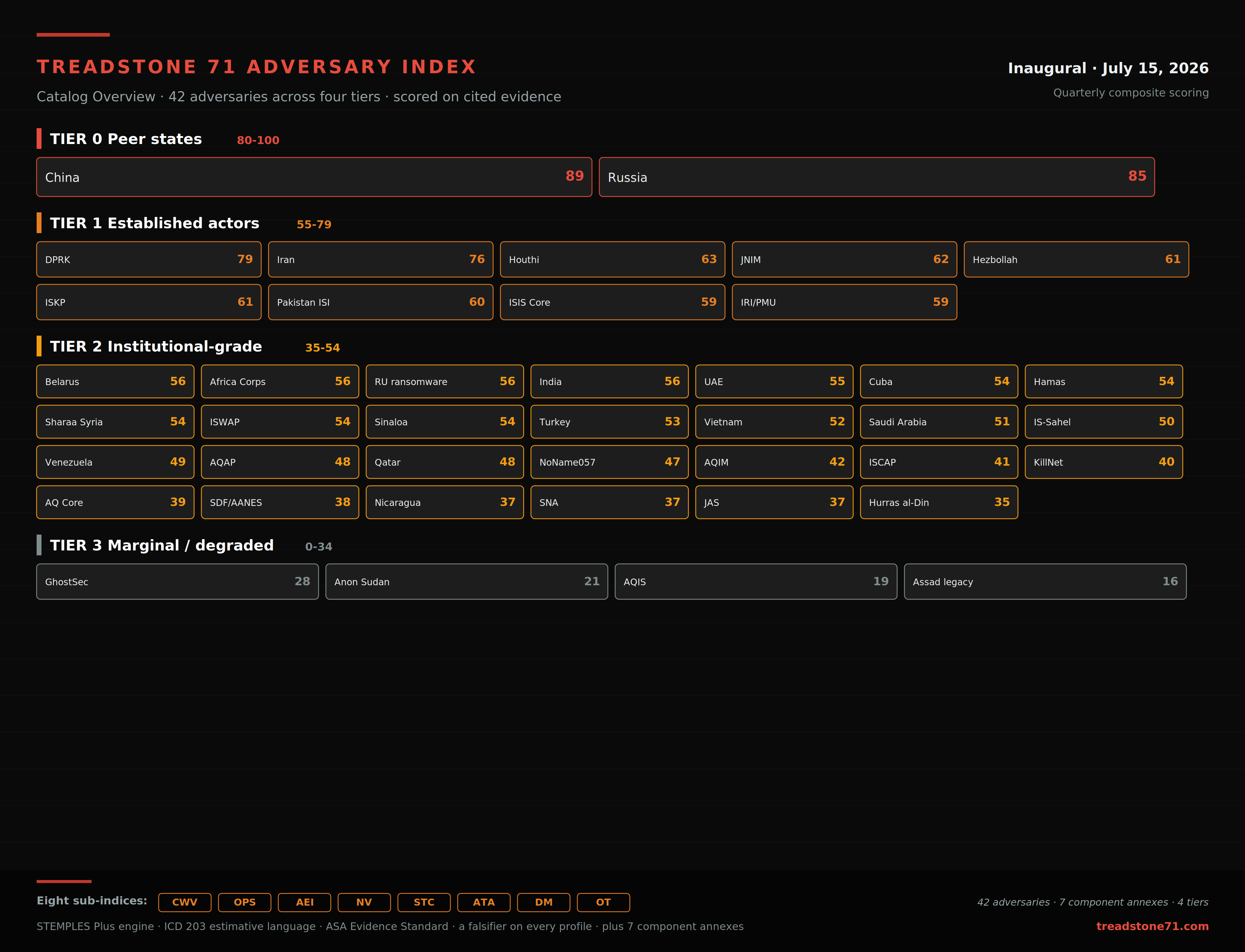
Treadstone 71 Adversary Index catalog overview, 42 adversaries across four tiers.
Defensive Posturing
Align security to verified risk
Scores translate cleanly into estimative language adhering strictly to Intelligence Community Directive 203. Read Sherman Kent probability conventions without ambiguity. We map numerical movements directly to analytic assertions. These six action bands are a defensive-response overlay, finer-grained than and distinct from the four catalog tiers (0-3) that organize the editions.
| Score | Posturing Band | Strategic Defense Action |
|---|---|---|
| 80 – 100 | Apex | Expect coordinated attacks across multiple sectors. Deploy maximum defensive resources immediately. |
| 65 – 79 | Mature | Anticipate focused operations against your industry. Your teams likely face highly structured intrusions. |
| 55 – 64 | Operational | Prepare for targeted strikes. Defenders hold roughly even chances of early detection. |
| 45 – 54 | Developing | Monitor for isolated breaches. Attackers remain unlikely to sustain large campaigns. |
| 35 – 44 | Nascent | Track emerging tactics. Adversaries probably lack resources for immediate harm. |
| 0 – 34 | Negligible | Maintain baseline security. Operations hold a remote probability of execution. |
Business Value
Measurement defeats guesswork
Security leaders struggle with qualitative threat reports. Anecdotes fail to secure budget approvals. Treadstone 71 provides a rigid, quantified metric. Directors compare threat actors using a standardized rubric. Extract immense strategic value immediately.
- Board reporting achieves clarity. Audit committees demand objective risk measurement. Executives secure absolute confidence defending investments.
- Procurement decisions gain financial justification. Security teams purchase specific threat platforms matching documented adversary capabilities. Eliminate wasteful software spending.
- Allied coordination operates smoothly. Agencies share a common, published metric eliminating methodological disputes. Multinational units execute joint defense seamlessly.
Immediate Escalation
Force multipliers require action
Three conditions force immediate organizational pivots. Documented field evidence confirms rapid threat escalation across sectors.
Adversaries weaponize artificial intelligence seamlessly
Russian, Chinese, Iranian, and DPRK formations deploy LLM-enabled narrative production routinely. Opponents direct automated deepfakes and agent-orchestrated influence networks. Organizations must defend against machine-speed attacks.
Estimative assessment: almost certainly (90–99%) production-grade AI-enabled cognitive operations run actively across primary state actors.Reporting failures leave organizations blind
Competing vendors offer fragmented data. You need a centralized, verified scoring system. No competing entity publishes a transparent, adversary-by-adversary composite score.
Estimative assessment: likely (55–70%) competing vendors attempt similar metrics within 18 months; unlikely (20–40%) competitors match our deep methodology.Directors demand quantifiable intelligence
Defense primes, financial institutions, and corporate boards require standardized benchmarks to measure true exposure. Establish the definitive internal metric.
Estimative assessment: probably (60–80%) the inaugural release establishes the global citation-default position.Threat Horizon
Anticipate exact adversary profiles
Score specific adversary classes constantly. Coverage expands deliberately. Prepare defenses against named units immediately following the July 15, 2026 release. Analysts fuse the Cultural Nexus Framework with integrated behavioral threat analysis. Detect, analyze, expose, counter, and contain hostile formations.
Defend Against State Actors
Counter the four primary nation-state adversaries. Receive complete operational blueprints addressing full-spectrum cognitive and cyber programs.
Track Proxy Networks
Security teams uncover hidden state-sponsored formations. Analysts map operations conducted by independent, high-capability groups across geographies.
Neutralize Major Syndicates
Defenders predict ransomware and hacktivist escalation. Block transnational criminal organizations conducting massive influence operations.
Monitor Emerging Threats
Analysts prepare for actors approaching operational maturity. Track specific groups before they reach the full evidentiary threshold.
What's Inside the Index
Treadstone 71 Adversary Index catalog overview, 42 adversaries across four tiers.
Strategic Investment
Scale defense to your exact needs
Organizations map procurement exactly to operational requirements. The initial public tier establishes baseline awareness globally. Paid tiers solve specific challenges for individual analysts, entire institutions, and executive boards. Secure your access today.
Each tier includes everything below it and adds a distinct class of capability - board framework, analyst operating, enterprise portfolio, executive decision advantage - not just more actors.
The Big Four at full three-tearline depth - strategic, operational, and tactical - the complete 42-actor field at catalog level, the scoring framework, and a board-level insight layer that shows what the ranking hides.
Download Free Edition →Everything in Free, plus the seven actors below the Big Four at full eight-sub-index depth - eleven scored in all - and the analyst operating layer: collection and hunt priorities, an indicator-of-change tripwire register, quarter-over-quarter movers, a responsibility matrix, and a resourcing and readiness read.
Purchase Subscription →Everything in Analyst, plus all 27 Tier 2 actors at STEMPLES Plus depth - 38 scored in all - and the institutional portfolio layer: cluster signatures, a sector-and-region exposure map, portfolio prioritization, and control-framework program mapping to NIST and CIS. The companion scoring workbooks included.
Purchase Subscription →Everything in Institutional, plus the four floor actors and the seven component annexes - the complete field - and the decision-advantage layer: a composite weighted to your organization, commissioned offensive active-probe operations under MNDA, degradation-pathway tracking, and scenario and wargame facilitation, delivered by a named senior analyst with quarterly board briefings.
Purchase Subscription →Verifiable Success
Three assessed strategic outcomes
Organizations deploy The Adversary Index to pursue three strategic outcomes, each documented with an explicit confidence band.
Establish the definitive standard
TAI becomes the required citation for national security reporting. Teams reference the quarterly composite natively during high-level briefings.
Strategic achievement: At least 50 independent press citations confirm global authority by Q3 2027.
Drive massive procurement decisions
Major defense contractors align purchasing strictly to TAI metrics. Justify threat intelligence platform investments mathematically.
Strategic achievement: Executive boards execute major infrastructure contracts referencing TAI data consistently.
Evolve defenses rapidly
Subscribers actively shape the methodology to match unique corporate needs. Direct analytic focus toward specific vulnerabilities.
Strategic achievement: Release the next methodology revision integrating institutional feedback directly.
Future Readiness
Secure your forward trajectory
Analysts evaluate four plausible market scenarios. Time procurement effectively to capture maximum defensive advantage.
Dominate the intelligence market
55–70% · LikelyEarly subscribers lock in strategic advantages immediately. Teams deploy the methodology of record against the Big Four state actors. Coverage expands into cybercrime ecosystems rapidly. Capture pristine data quality and direct influence over future updates.
Navigate competing metrics
20–30% · Unlikely-to-Roughly-EvenCompeting agencies attempt similar releases. TAI maintains superiority through deep, transparent methodology. Benefit from cross-index validation continuously.
Achieve consortium standardization
15–25% · UnlikelyAllied forces adopt Treadstone 71 methodology broadly. Our Standard becomes the baseline requirement for multinational defense operations. Operate using the universally accepted metric.
Sustain steady growth
10–15% · UnlikelyThe citation flywheel accelerates reliably over extended periods. Subscribers hold profound analytical value while the broader market catches up.
Absolute Independence
Trust the process completely
Executives rely on absolute editorial integrity. Treadstone 71 separates scoring from consulting strictly. Every quarterly release completes a brutal four-stage validation cycle: collection, dual-analyst arbitration, Editorial Board challenge, and embargo review.
External reviewers challenge scoring aggressively. Experts from academia and former government agencies hold veto authority. Receive completely unbiased threat assessments.
Analysts never alter numbers for commercial gain. Teams assigned to index generation avoid direct consulting with implicated corporations. We publish conflict-of-interest disclosures quarterly.
The ASA Evidence Standard methodology white paper publishes September 15, 2026. Every TAI score carries its source and evidence grading under that standard.
Operational Reliability
Execute exactly on schedule
Security centers depend on predictable intelligence delivery. TAI runs on an unbreakable editorial calendar. Synchronize internal briefings perfectly to our release cycles. The next public release lands October 5, 2026, carrying the Q3 refresh and the inaugural Cognitive Warfare Threat Report (CWTR).
- Days 1 – 15 — Analysts lock scoring against the rubric.
- Days 16 – 30 — Editorial Boards challenge every quarterly delta exceeding five points.
- Days 31 – 45 — Teams assemble the public artifact and brief external counsel.
- Days 46 – 60 — Subscribers receive embargoed pre-release data.
- Day 61 — Access the public release precisely at 0900 Eastern.
- Days 62 – 90 — Analysts monitor errata and calibrate the next quarter instantly.
Common Questions
What executives ask before they subscribe
What does The Adversary Index measure?
The Adversary Index scores nation-state and non-state attackers on a 0 to 100 composite. Analysts rate executed operations, not rumored intent. Eight distinct vectors feed the number, from narrative production speed to operational tempo. A higher score marks greater operational maturity and a sharper defensive requirement.
How do analysts calculate the composite score?
Teams score each of the eight vectors from 0 to 100 against a transparent rubric. Analysts then average the eight vectors to set the composite for each adversary. Anomaly and aggregation analysis expose hidden patterns across the field. Every quarter, scoring locks against the same rubric, so movement reflects real change rather than shifting standards.
Which eight vectors build the score?
The composite draws on Cognitive Warfare Velocity, OPSEC Sophistication, the Adaptation/Evolution Index, Narrative Volume, Sectoral Targeting Concentration, AI Tradecraft Adoption, Doctrinal Maturity, and Operational Tempo. Each vector isolates one measurable trait of adversary behavior. Together the eight produce a normalized read of capability and reach.
How do the six posturing bands differ from the four tiers?
The six posturing bands — Apex, Mature, Operational, Developing, Nascent, and Negligible — translate a score into a defensive response. A score of 80 to 100 lands in Apex and calls for maximum defensive resources. The four catalog tiers, 0 through 3, organize the published editions and pricing instead. Bands describe threat severity; tiers describe what a subscriber receives.
How many adversaries does the Index cover?
The catalog names 42 adversaries plus seven component annexes across four tiers. Coverage splits into Class A state actors, Class B proxy networks, Class C criminal syndicates, and a Watch List of groups approaching operational maturity. Analysts expand coverage deliberately as evidence meets the scoring threshold.
When does the Index release, and how often does it update?
The inaugural edition released July 15, 2026. The next release lands October 5, 2026, carrying the Q3 refresh and the inaugural Cognitive Warfare Threat Report (CWTR). The ASA Evidence Standard methodology white paper publishes September 15, 2026. After launch, the Index runs on a quarterly cycle governed under a 90-day editorial calendar. Analysts lock scoring in the first 15 days, face Editorial Board challenge on every delta above five points, then publish the public artifact at 0900 Eastern on the set date. Subscribers receive embargoed pre-release data ahead of the public drop.
What comes with the free Tier 0 edition?
Tier 0 costs nothing and sets the board's baseline. Readers receive the Big Four at full three-tearline depth — strategic, operational, and tactical — the complete 42-actor field at catalog level, the scoring framework, and a board-level insight layer that shows what the ranking hides. One download delivers the full free edition.
What separates the three paid tiers?
Each paid tier includes everything below it and adds a distinct class of capability. Tier 1 Analyst, at $25,000 a year, scores 11 actors at full eight-sub-index depth and adds the analyst operating layer: collection and hunt priorities, a tripwire register, and quarter-over-quarter movers. Tier 2 Institutional, at $75,000 a year, scores 38 actors at STEMPLES Plus depth and maps controls to NIST and CIS. Tier 3 Executive Desk, at $250,000 a year, delivers the complete field, a composite weighted to your organization, and quarterly board briefings from a named senior analyst.
What are the offensive active-probe operations in Tier 3?
Tier 3 subscribers commission offensive active-probe operations under a mutual non-disclosure agreement. Analysts test an adversary's live posture, then track degradation pathways over time. Scenario and wargame facilitation round out the engagement. The offensive layer stays contract-bound and runs only under written authority.
How does Treadstone 71 keep scoring independent?
Treadstone 71 separates scoring from consulting. Every release completes a four-stage validation cycle: collection, dual-analyst arbitration, Editorial Board challenge, and embargo review. Reviewers from academia and former government service hold veto authority over the numbers. Analysts assigned to the Index avoid direct consulting with implicated firms, and the firm publishes conflict-of-interest disclosures each quarter.
What probability language does the Index use?
Scores translate into estimative language that follows Intelligence Community Directive 203 and Sherman Kent conventions. Assessments read in plain probability terms — almost certainly, likely, roughly even, unlikely — each tied to a numeric range. The method separates verified fact from adversary claim and marks the confidence behind every judgment.
Who benefits most from The Adversary Index?
Corporate boards, defense primes, financial institutions, and government agencies gain the most direct value. Boards justify budget with a standard metric. Security teams match platform purchases to documented adversary capability. Allied units share one published score and skip methodological disputes. Journalists and researchers apply for separate press access.
Initiate Defense
Equip your team with predictive intelligence today
Download the free public artifact immediately. Secure enterprise-wide defense by subscribing to Tier 1, Tier 2, or Tier 3 capabilities. Journalists and researchers apply for press access instantly.
